Enterprise SaaS · Advertising Technology

Designing an enterprise advertising platform that organizes complexity instead of hiding it.

Multi-tenant advertising operations made calm, scalable, and learnable.

Orion is a multi-tenant Demand Side Platform used internally by Version2 and Magnitude of Change to plan, launch, manage, and optimize digital advertising campaigns. The redesign reframed Orion from a stack of dashboards into one connected ecosystem—organized around roles, workflows, and the questions operators ask in the moment: Where am I? What can I do? What happens next?

Role
Lead Product Designer
Timeline
Approximately 4 months
Industry
Enterprise SaaS · Advertising Technology
Team
Lead Product Designer (me) · 2 Software Engineers
Why It Mattered

Before the answer,the tension that demanded one.

Orion already existed, but its experience treated every screen as a standalone surface. Operators were asked to hold the structure of the business in their head while making consequential decisions inside dense workflows. The redesign had to organize complexity, not hide it.

01

Multi-tenant Hierarchy

Administrators, agencies, brands, and campaign teams used the same product, but the interface gave them no orientation across roles.

02

Dense Datasets

Performance tables and campaign lists scaled past the patterns the old UI was built for, forcing operators to scroll and re-scan to find signal.

03

Campaign Creation Friction

Setup required many high-stakes decisions across targeting, creative, and review with no guided structure to lean on.

04

Inconsistent Components

Buttons, tables, forms, and status patterns drifted between surfaces, eroding trust and slowing engineering.

I do not need fewer features. I need the platform to tell me where I am.
CAMPAIGN OPERATOR, VERSION2
The System

The shape of the problemmade visible.

Signature Visual · Platform Architecture

One platform. Every tier of the business.

Orion supports administrators, agencies, brands, and campaigns inside a single, multi-tenant system. The architecture had to be legible at every level—so the same product could feel calm to a brand manager and powerful to an admin.

Orion was designed as one connected ecosystem rather than a stack of isolated dashboards. Each tier inherits the same components, hierarchy, and language—so an admin and a brand manager experience the same product, scaled to their role. With the platform architecture established, the next challenge was simplifying the day-to-day experience of campaign management.

The Opportunity

The betsthat earned the build.

Problem

Campaign creation and management forced operators to make many decisions with little guidance, navigate large datasets without orientation, and reconcile inconsistent patterns across tenants.

Opportunity

Treat Orion as one ecosystem instead of isolated dashboards, so every workflow answers three questions at every step: Where am I, what can I do, and what happens next?

Outcome

A scalable, role-aware platform where administrators, agencies, brands, and campaign teams share one cohesive experience—reducing cognitive load and establishing a foundation for long-term growth.

The principles we held to.

  1. 01Reduce cognitive load at every step.
  2. 02Guide operators through complexity, do not hide it.
  3. 03Design for long-term scalability, not the next screen.
Final Experience

The product.Revealed surface by surface.

The shipped platform organizes Orion around roles and workflows. Each surface leads with orientation, surfaces information progressively, and reuses a shared component library so the experience holds up at every tier.

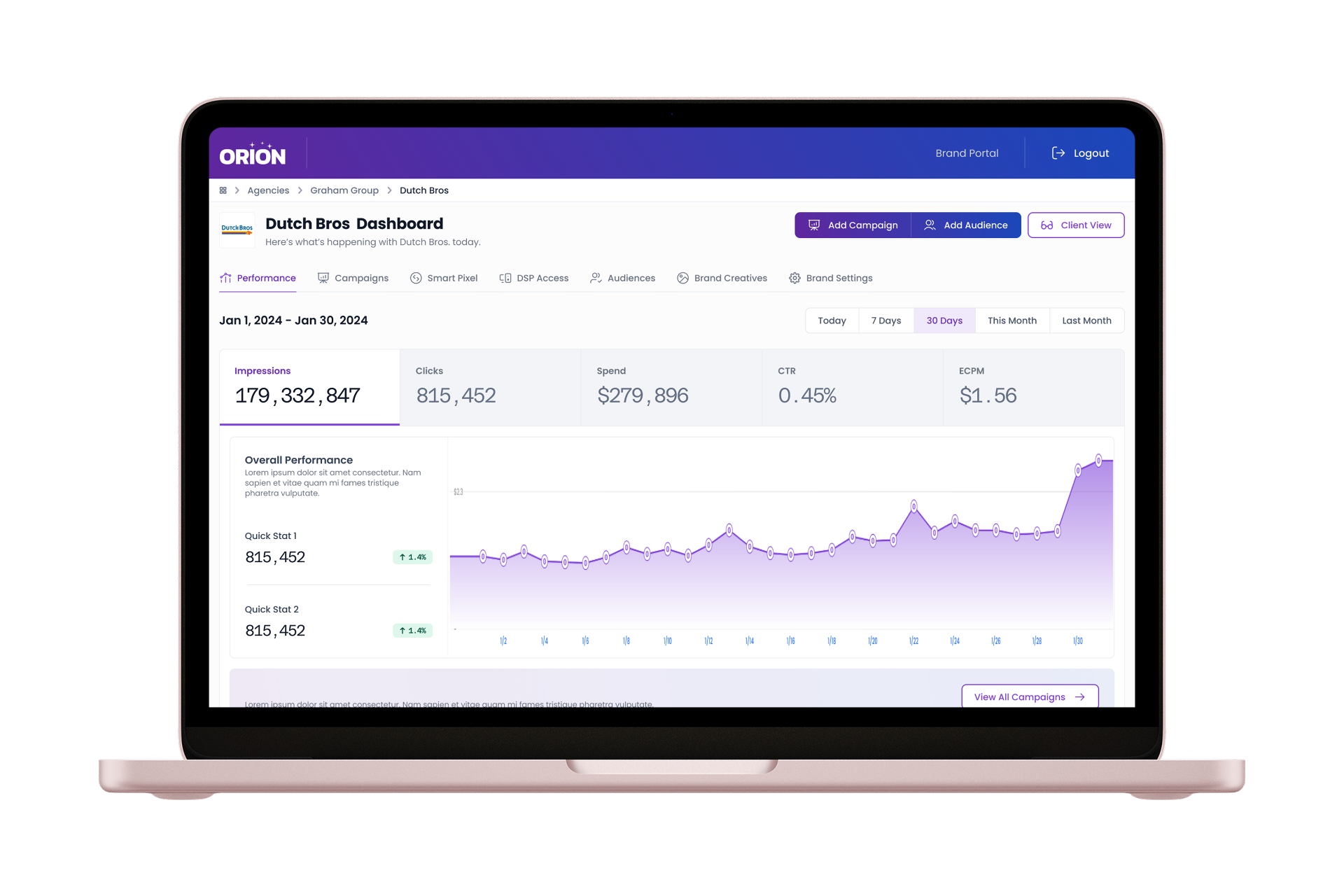
Surface 01

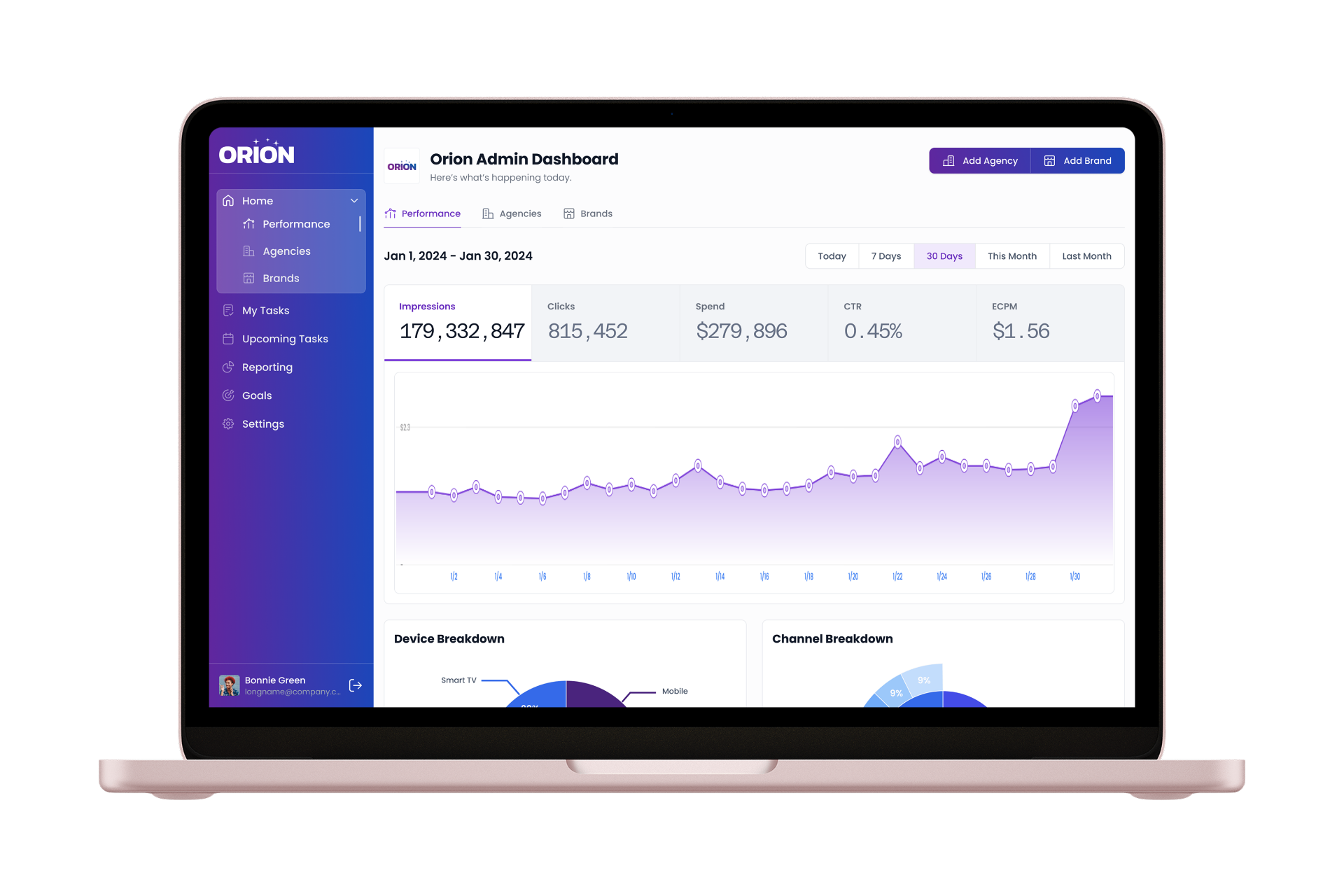
Analytics that lead with signal

Orion admin dashboard performance overview
Problem

Operators could not tell at a glance how campaigns were performing or what to act on next.

Outcome

Operators moved from scanning tables to scanning meaning, with the next action always one click away.

Surface 02

Guided campaign creation

Problem
Campaign setup demanded many decisions across targeting, creative, and review with no scaffolding.
Solution
A four-step workflow—Information, Targeting, Creatives, Review—uses progressive disclosure to keep each step focused and recoverable.
Impact
Operators completed setup with fewer dead ends and more confidence before launch.
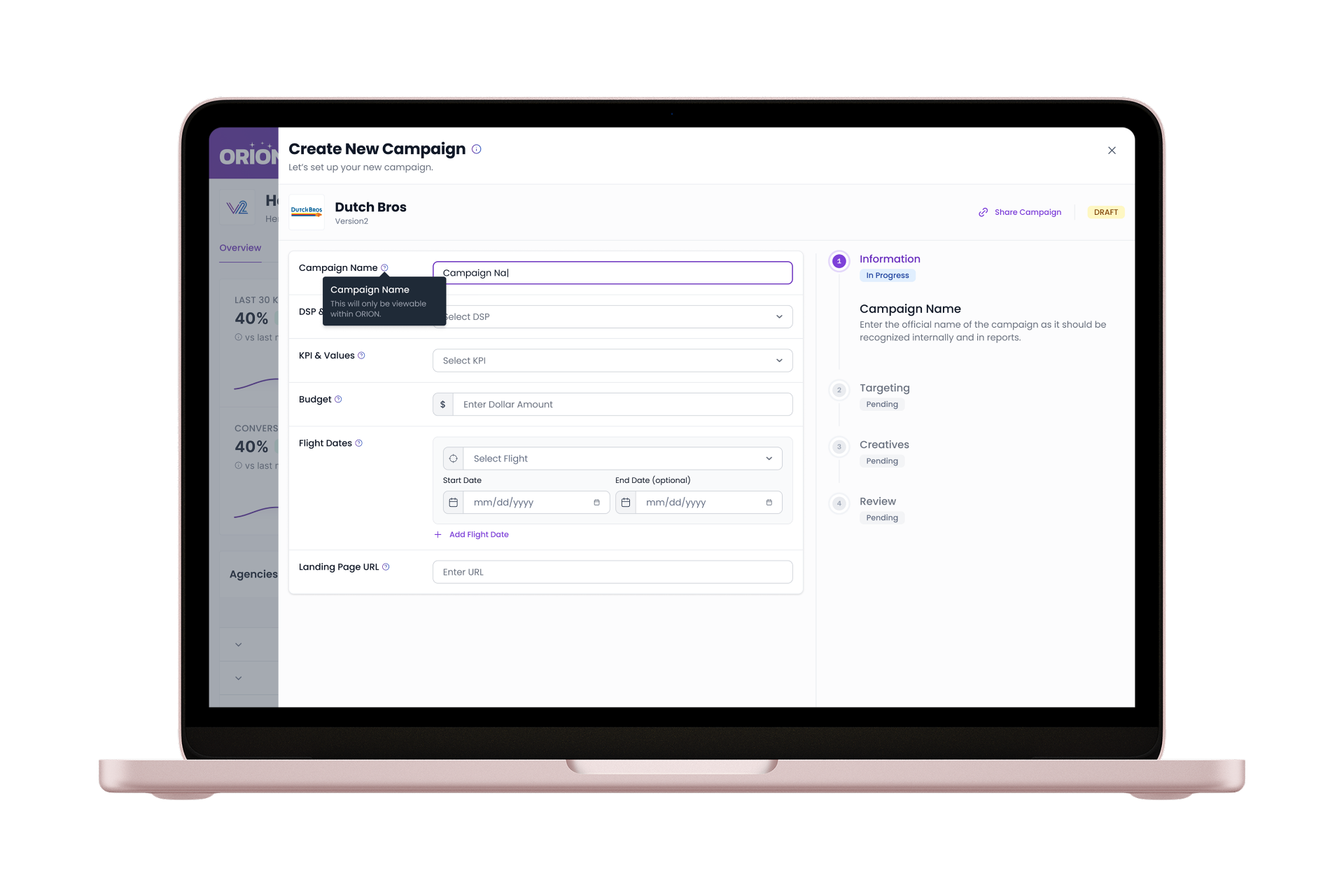
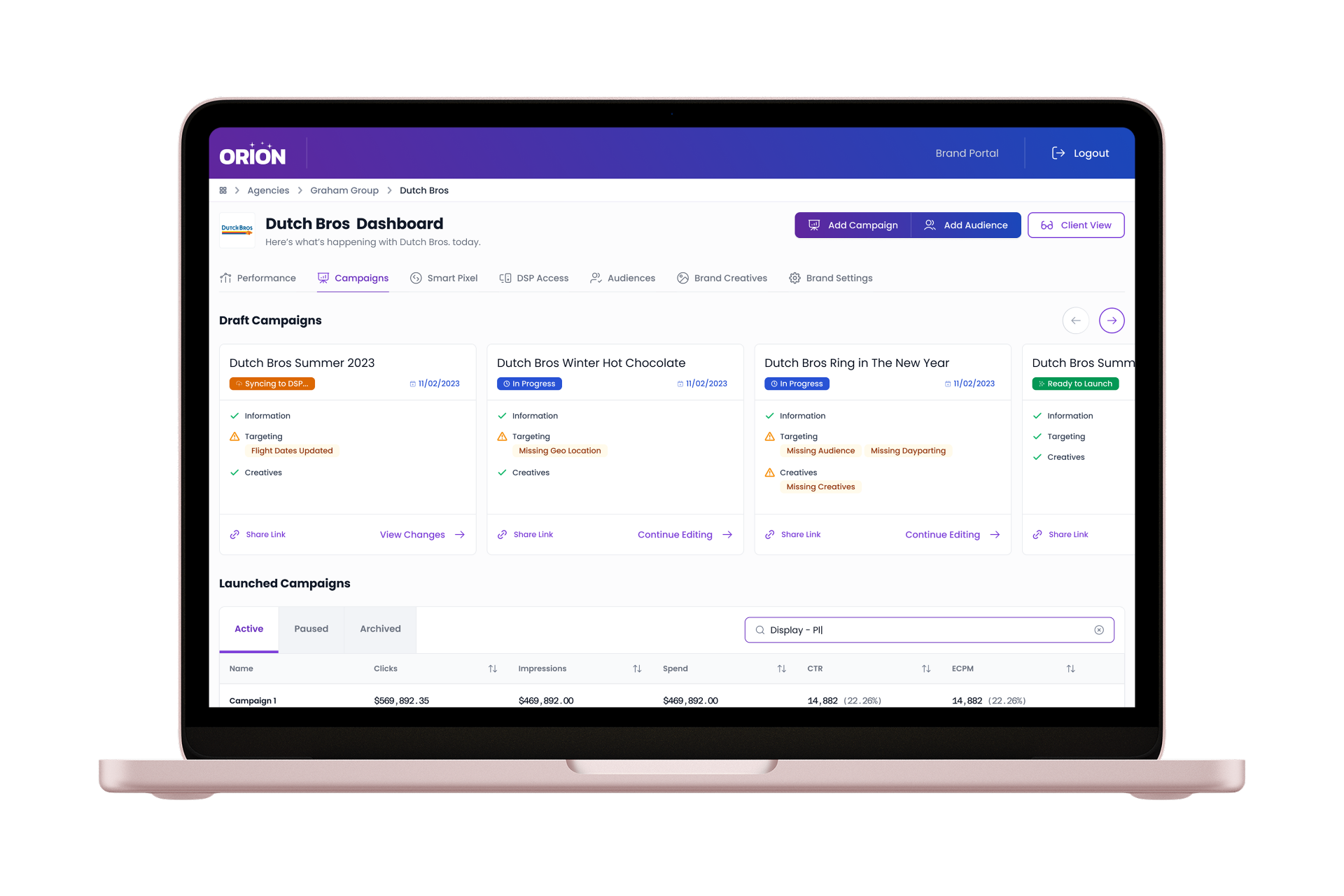
Guided campaign creation modal
Surface 03

Brand experience scaled to the work

Problem
Brand managers were forced through agency-level complexity to manage their own campaigns.
Solution
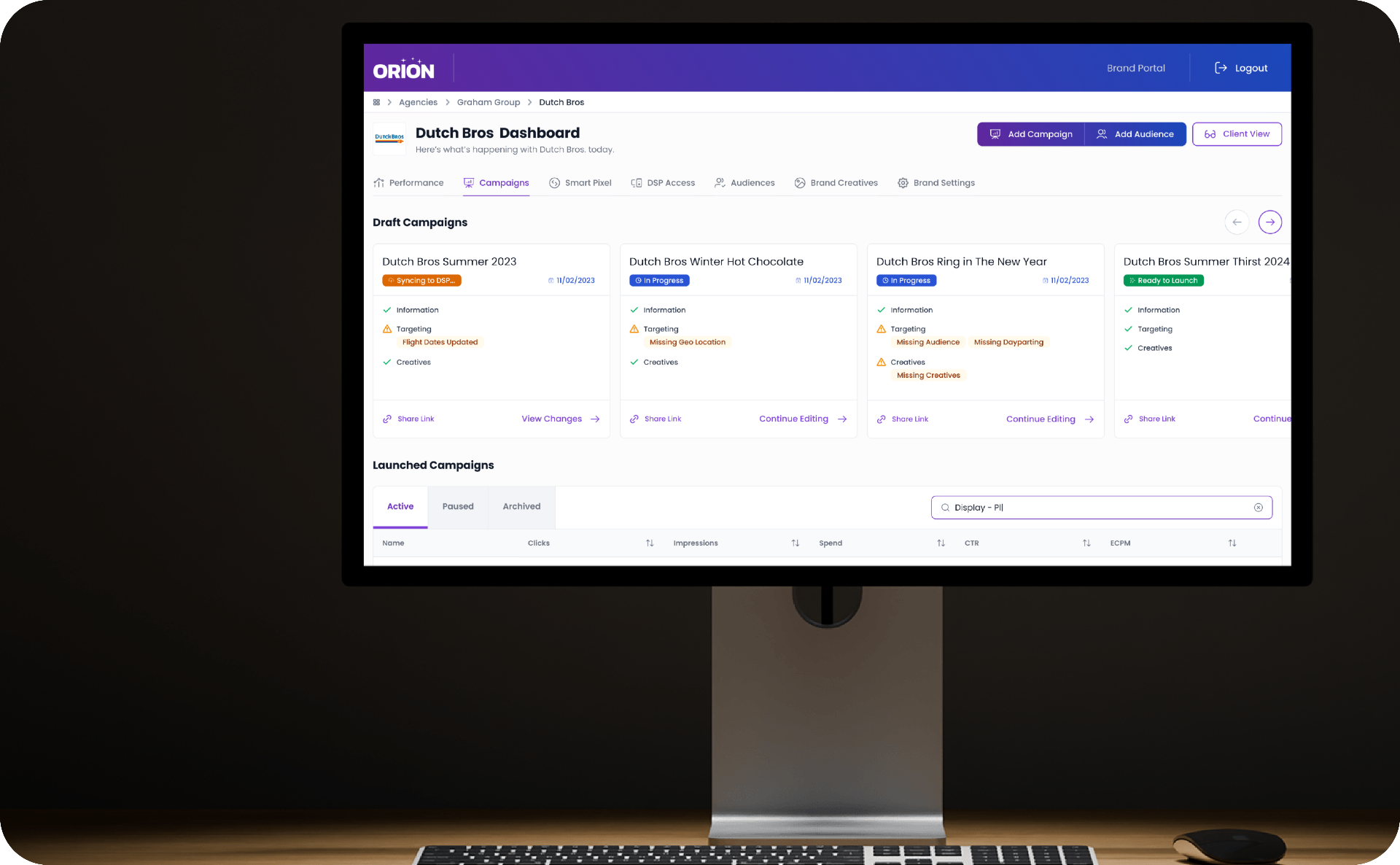
A brand-tenant surface focused on campaign management, performance, status, draft workflows, and analytics—without unnecessary platform overhead.
Impact
Brands operated their portfolios with calm, role-appropriate density.
Brand portal campaign management
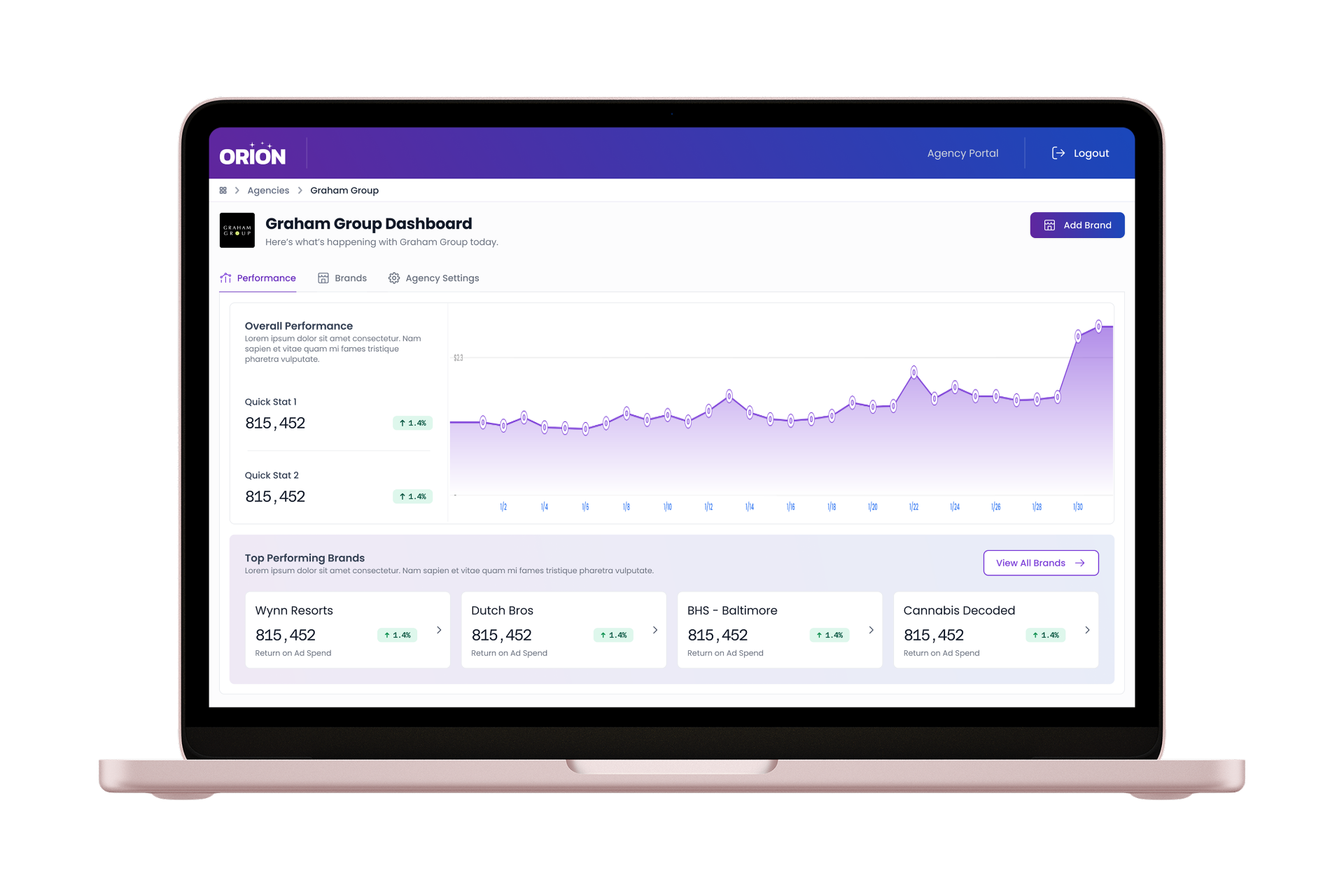
Surface 04

Agency oversight across portfolios

Problem
Agencies needed to oversee multiple brands without losing context between them.
Solution
An agency-tenant surface for portfolio management, cross-brand reporting, organization, and administration—built on the same components as brand and campaign tools.
Impact
Agencies shifted from juggling tenants to orchestrating them.
Brand dashboard with performance analytics
Surface 05

Administrator platform controls

Problem
Admins lacked a coherent surface for permissions, organization management, and platform oversight at scale.
Solution
An admin-tenant surface for permissions, platform oversight, organization management, and scalability—anchored to the same hierarchy operators experience downstream.
Impact
Platform governance became a first-class experience instead of a settings drawer.
Agency portal dashboard
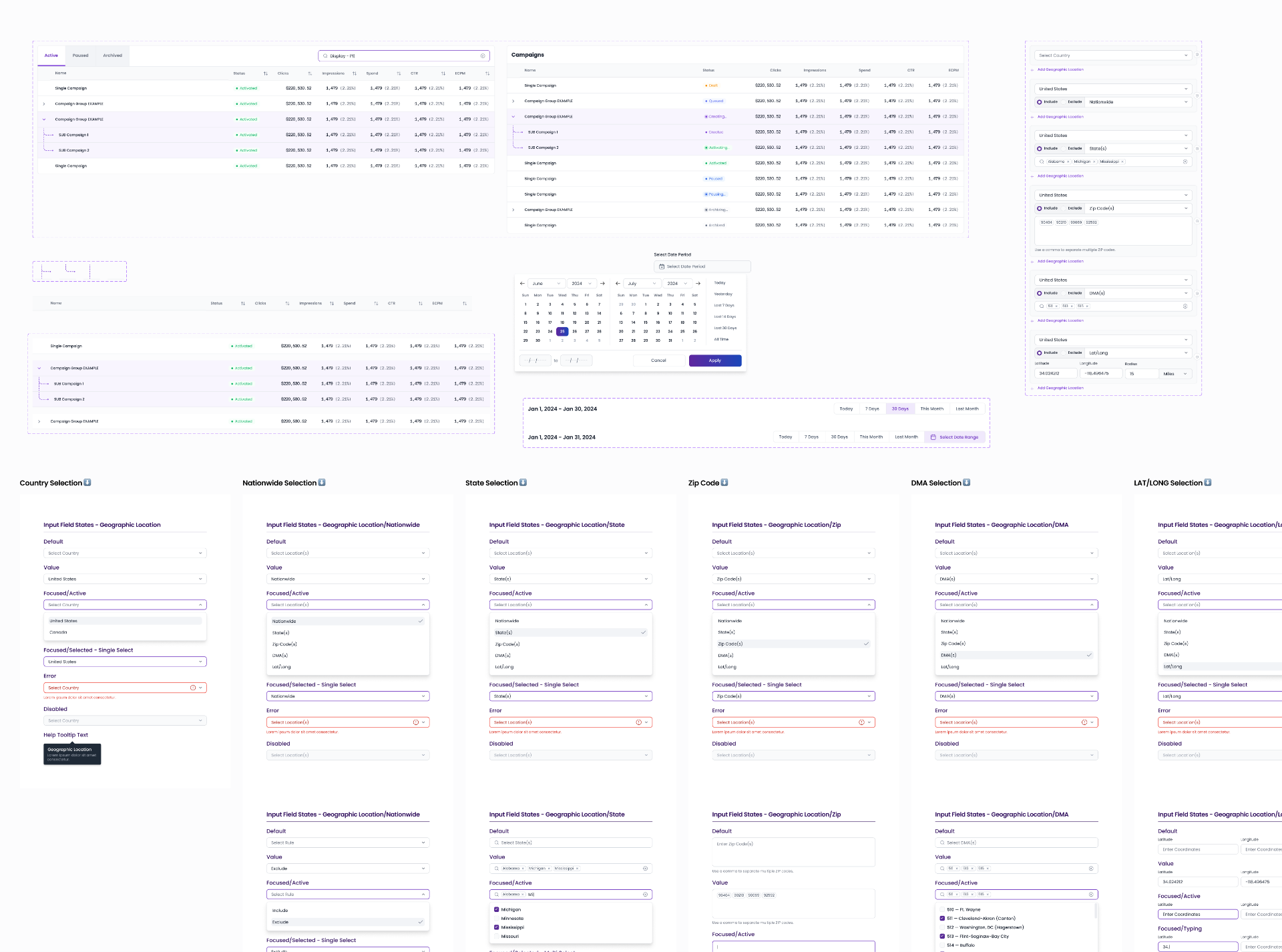
Surface 06

Refined system foundation

Problem
Drifted buttons, tables, forms, charts, and status chips eroded trust and slowed engineering.
Solution
A refined design system—buttons, tables, charts, cards, badges, forms, progress, status chips, inputs, dropdowns, tabs—powers every Orion surface from one source of truth.
Impact
Consistency improved usability for operators and accelerated implementation for engineering.
Design system components and specifications
Design System

Built to outlast.Launch day.

Every surface ships from a shared system — tokens, components, and patterns documented so future teams can extend the product without re-deriving its rules.

UX Strategy
Information Architecture
Product Thinking
UI Design
Design System
Workflow Optimization
Developer Collaboration
The Impact

The outcome.across the business.

platform

One

Replacing fragmented admin, agency, brand, and campaign experiences with one connected enterprise product.

workflows

Guided

Transforming campaign creation from scattered configuration into a clear, step-by-step experience.

language

Shared

Establishing one design system across products, teams, and future releases.

cognitive load

Lower

Reducing unnecessary complexity so operators can focus on campaigns instead of interfaces.

product delivery

Faster

Reusable components and consistent patterns accelerated implementation across the platform.

to scale

Built

Creating a flexible foundation that could support future products, tenants, and evolving business needs.

Orion unified a fragmented advertising platform into a cohesive enterprise ecosystem. Instead of asking users to adapt to disconnected tools, the product established one consistent language across tenants, workflows, and campaigns—making complex operations feel predictable, scalable, and easier to navigate.

Reflection

What worked.What I'd build next.

What changed

Reframing Orion as one ecosystem instead of a stack of dashboards. Once roles, workflows, and components shared the same backbone, every later decision became easier and faster.

What surprised me

How much confidence came from orientation alone. Telling operators where they were and what came next moved the experience before any visual changes shipped.

What I'd build next

I would invest in the design system even earlier. Every surface built on the refined system shipped faster and held together better than the surfaces that retrofitted it.

Next Chapter

Let's build the nextsuccess story.

Every case study in this portfolio began with a complex problem, an ambitious team, and a decision to build something better. If you’re solving the next one, I’d love to help write its success story.