Brad La Pointe
Venture Sprint · Public Sector

Turning ambiguity into alignment at venture speed.

A two-week Venture Sprint that turned an early government-services concept into a clear, stakeholder-aligned product vision.

Service Oklahoma began as an ambiguous, early-stage concept for consolidating fragmented state services. In a focused two-week Venture Sprint, I led the product strategy, UX direction, systems thinking, and executive storytelling required to move from scattered ideas to a single, defensible product vision — captured in a pitch-ready narrative and vision artifacts a leadership team could align around and act on.

Role
Product Strategy · UX Direction · Systems Thinking · Interaction Design · Product Storytelling · Venture Pitch Visualization · Executive Presentation Design
Timeline
2 Weeks · Venture Sprint
Industry
Venture Sprint · Public Sector
Team
Solo design lead · Executive stakeholders · Product & policy SMEs
Why It Mattered

Before the answer,the tension that demanded one.

A Venture Sprint gets called in when scope is unclear, stakeholders disagree, and the calendar refuses to wait. Service Oklahoma had all three — the work was to turn that ambiguity into a vision leadership could commit to in two weeks.

01

Undefined scope

The initiative had ambition but no clear boundaries — every stakeholder was solving a slightly different problem.

02

Competing internal opinions

Multiple leaders held partial, conflicting mental models of what the product should be.

03

Aggressive timeline

Leadership needed a defensible direction in two weeks, not two quarters — before enthusiasm faded.

04

No shared narrative

Without a single story, every decision restarted from zero and consensus never held.

In two weeks we went from scattered ideas to one picture everyone could rally behind.
Executive stakeholder, initial pitch review
The System

The shape of the problemmade visible.

Signature Visual · Strategic Experience Framework

A strategic shift from agency-centric services to life-event-centric experiences.

One agency. Every life event. A single path forward.

From
Agency-Centric Services
To
Life-Event-Centric Experiences
  1. Stop 01
    New to Oklahoma

    First license, vehicle, voter registration in one visit.

    Start once. Belong everywhere.

  2. Stop 02
    Family change

    Marriage, name updates, dependents handled in one flow.

    Life changes should update everything.

  3. Stop 03
    Moving home

    Address syncs across every state record automatically.

    Moving shouldn’t mean starting over.

  4. Stop 04
    Business or vehicle

    Title, registration, and tax in a single transaction.

    Business should feel as simple as personal.

  5. Stop 05
    Renewals

    Reminders, eligibility, and payment without re-explaining.

    Renewals should happen automatically.

The Opportunity

The betsthat earned the build.

Problem

An early-stage concept without shared definition — scope, priorities, and vision were all unresolved, and the timeline demanded alignment fast.

Opportunity

Compress weeks of ambiguity into a two-week Venture Sprint that produces one narrative, one framework, and one pitch executives can align around.

Outcome

A stakeholder-aligned product vision and executive pitch delivered in two weeks — the alignment artifact that moved the initiative from ambiguity into a committed direction.

The principles we held to.

  1. 01Lead with the person, not the policy.
  2. 02Make the next step obvious at every moment.
  3. 03Design for the hardest day, not the easiest user.
Final Experience

The product.Revealed surface by surface.

The Venture Sprint delivered a single, aligned product vision — presented through a life-event framework, three guiding principles, and a set of vision surfaces used to make the direction tangible for executive stakeholders.

Feature 01

A renewal that starts with "do I qualify?"

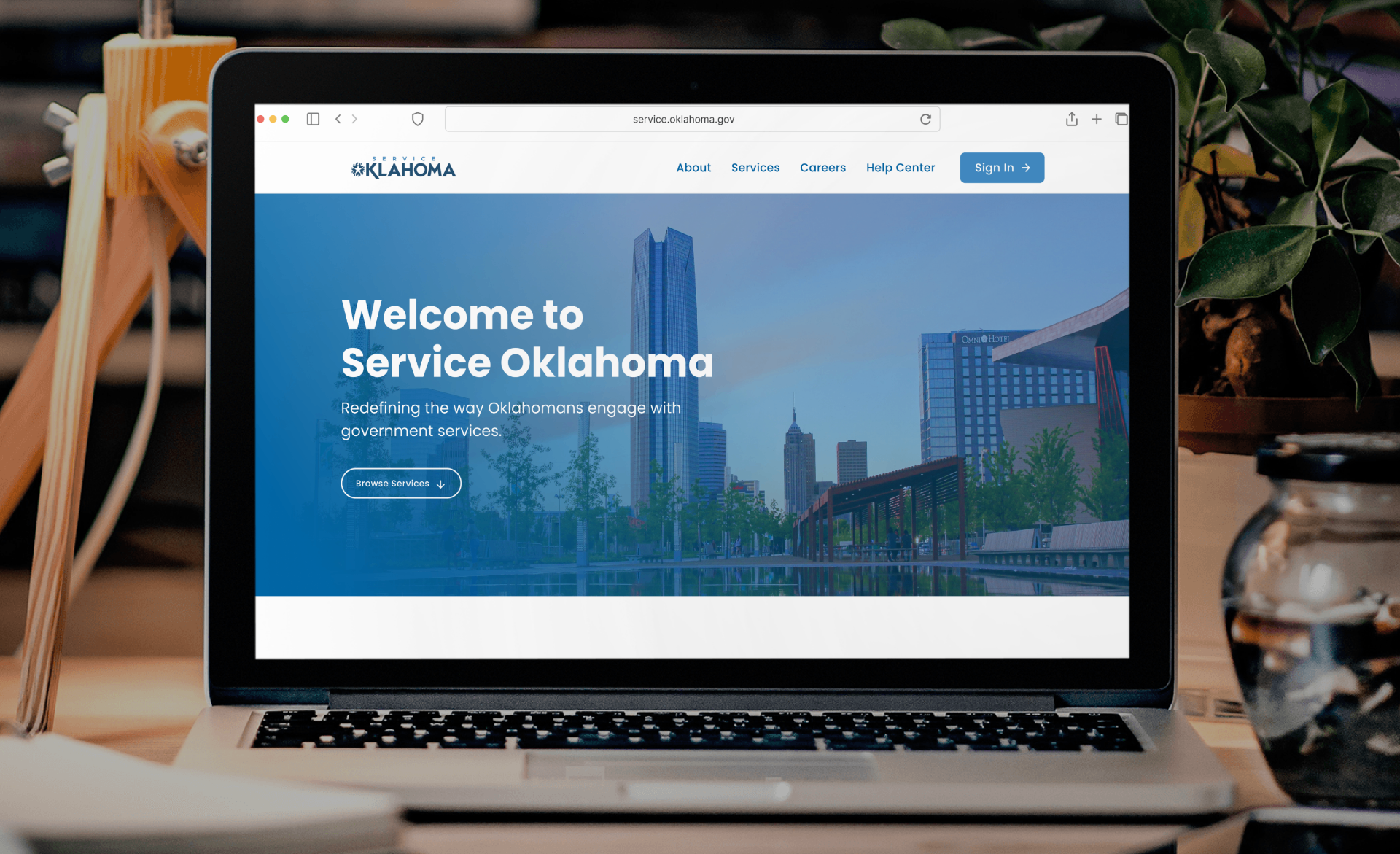
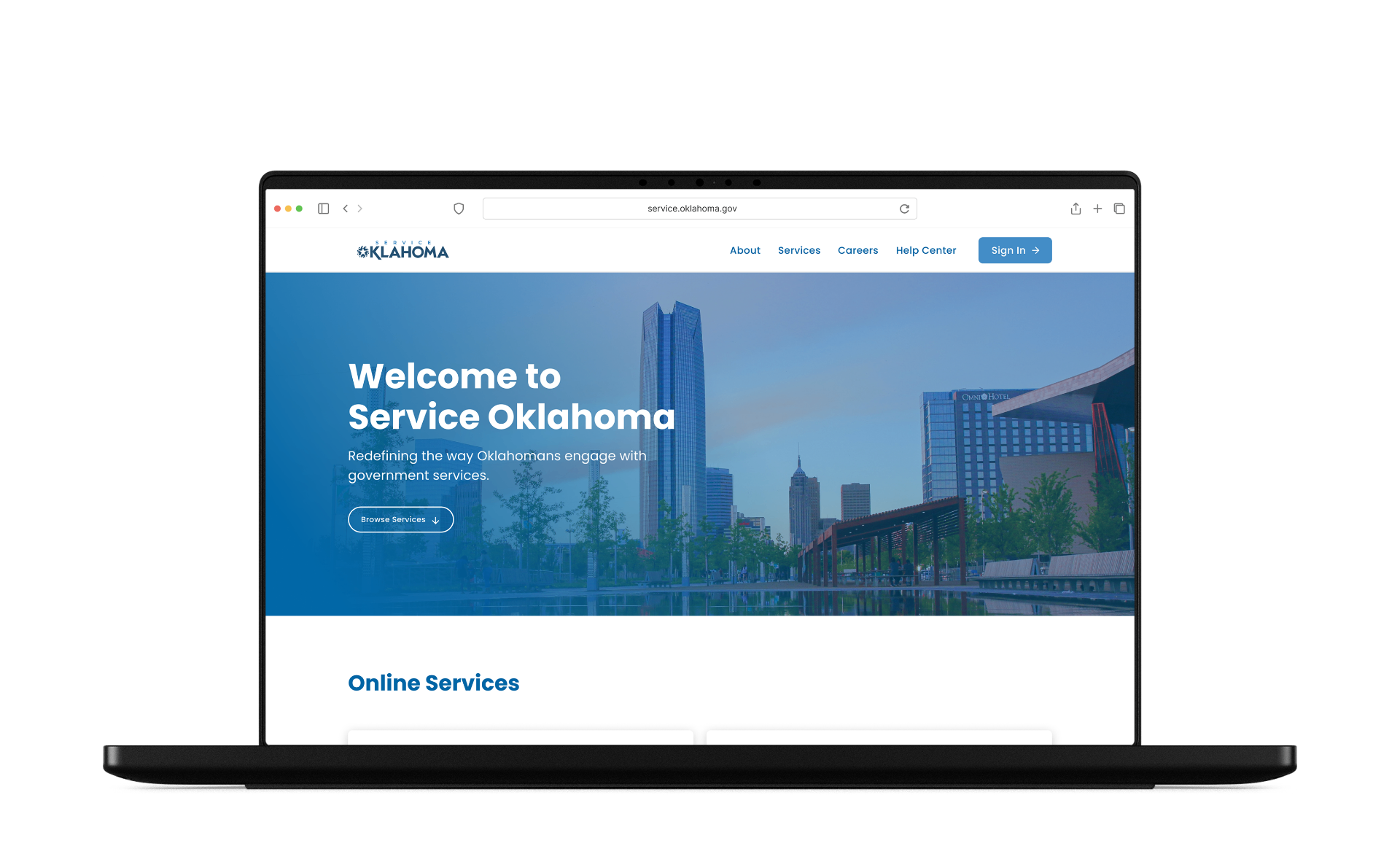
Service Oklahoma homepage with hero and Online Services.
Problem

Residents began every renewal unsure if their situation was even eligible online.

Outcome

Residents make an eligibility decision in under a minute instead of abandoning mid-form.

Feature 02

One decision per screen, always

Problem
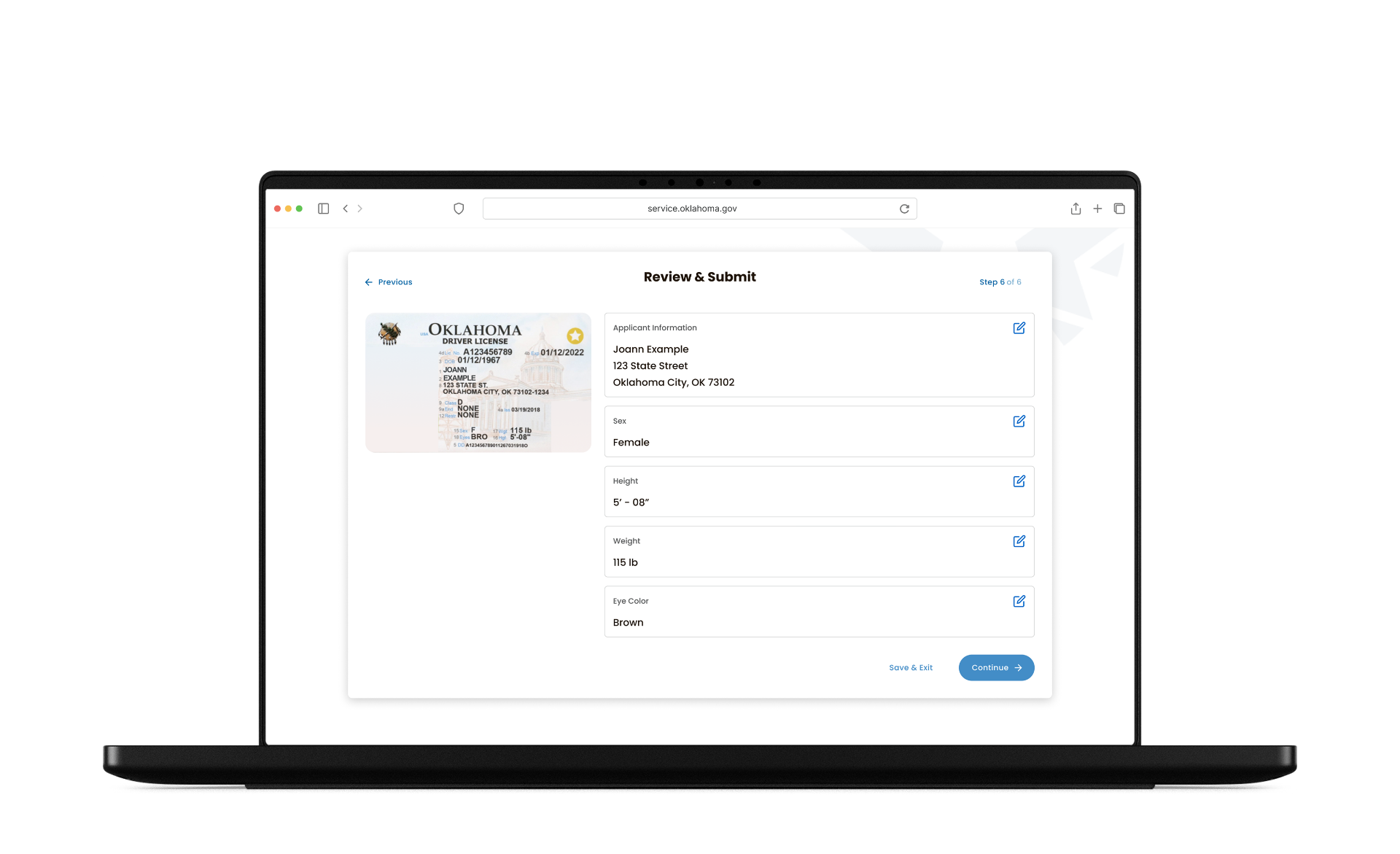
Legacy renewals stacked identity, documents, payment, and consent onto dense multi-column pages.
Solution
The renewal flow was rebuilt as a linear, one-thing-at-a-time sequence — verify identity, confirm documents, review, pay, confirm — with a persistent step indicator and saved progress across devices.
Impact
Renewals feel like a guided conversation instead of a form dump, and drop-off between steps flattened.
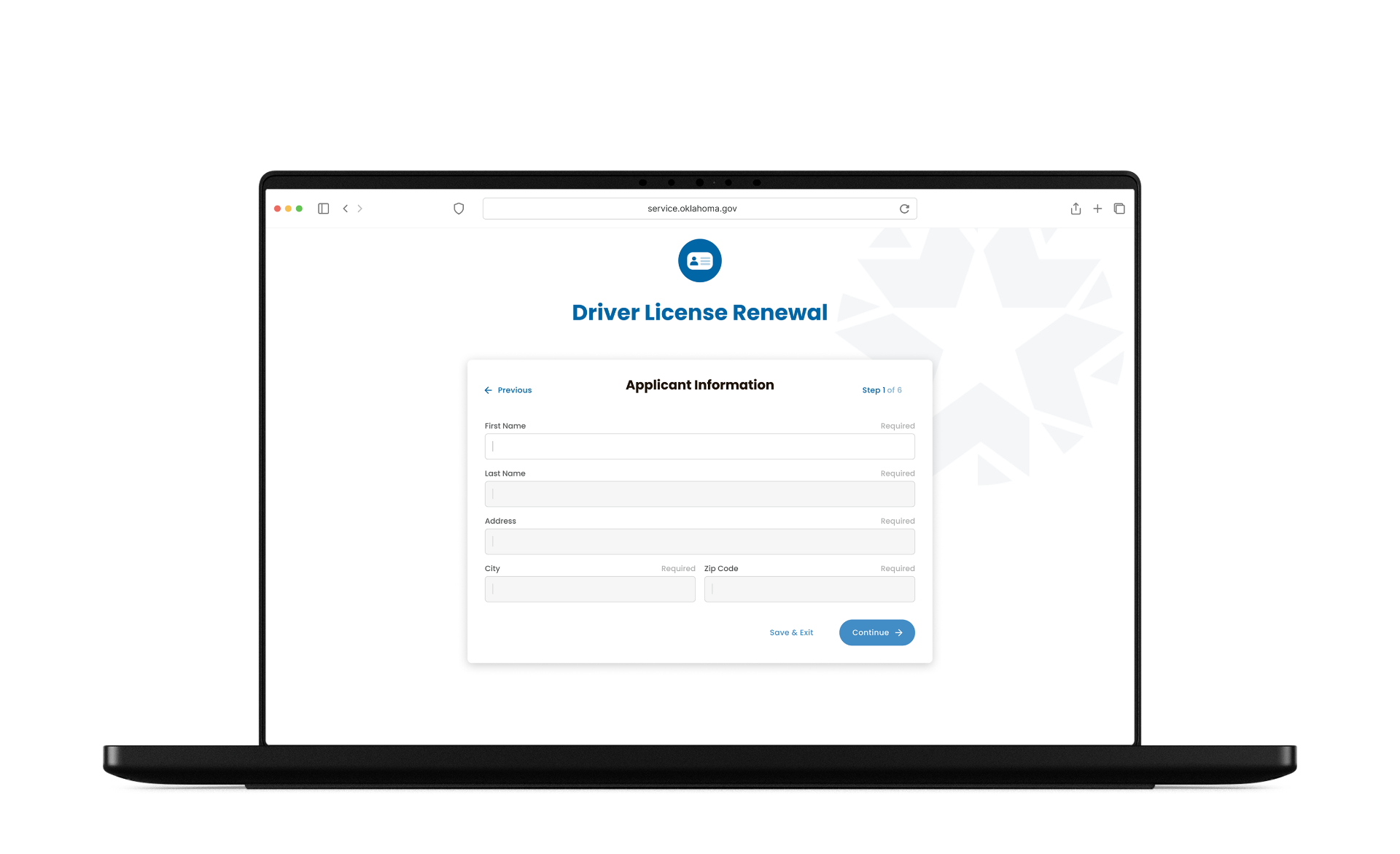
Driver License Renewal — Applicant Information step.
Feature 03

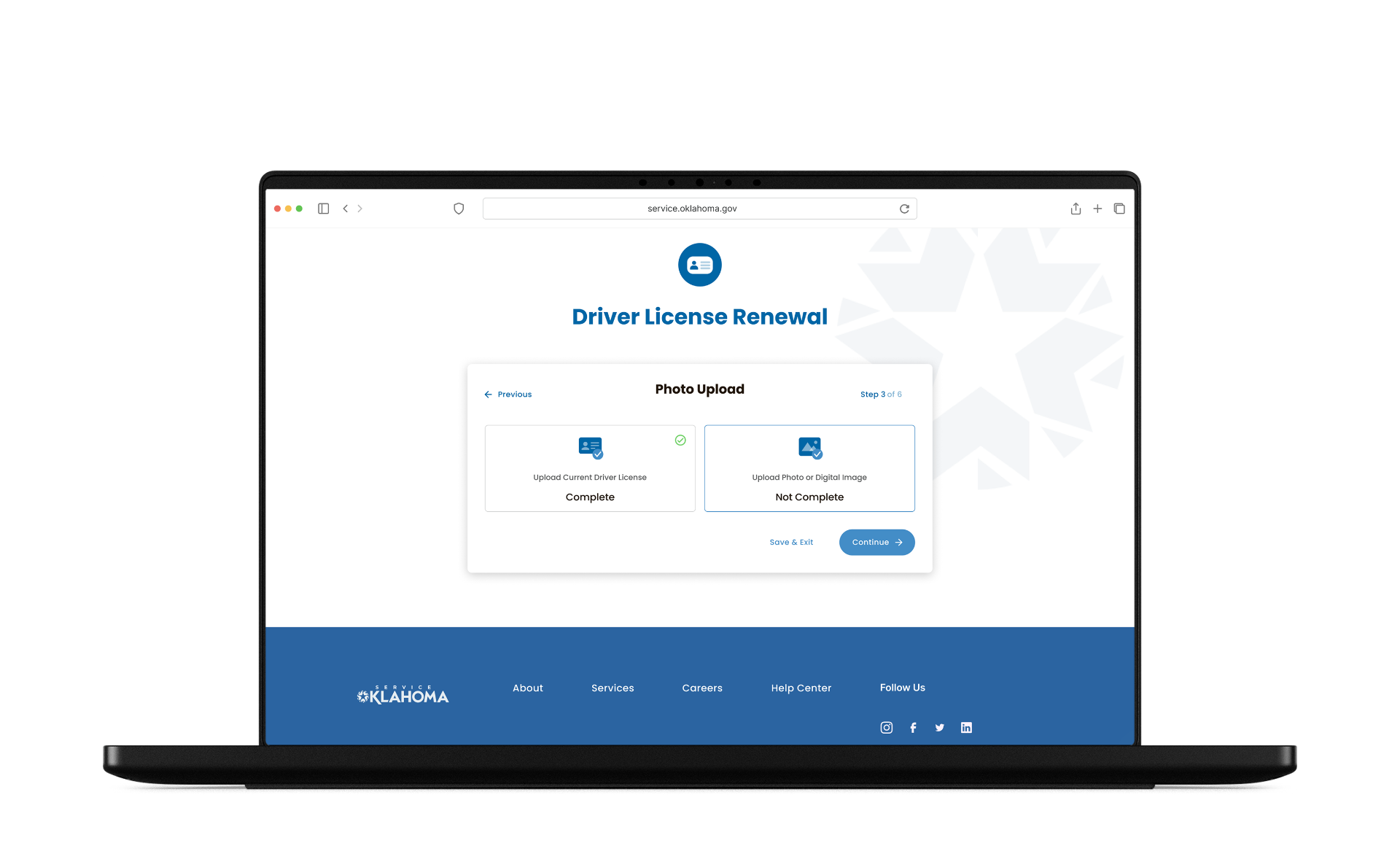
Dynamic document checklist

Problem
Missing paperwork was the single largest cause of failed renewals and repeat trips.
Solution
A dynamic checklist adapts to the resident's answers — Real ID vs. standard, first-time vs. renewal, in-state vs. out-of-state — and explains each item in everyday language before verification begins.
Impact
Residents arrive prepared, and same-visit completion rises without extra staff effort.
Driver License Renewal — Photo Upload step.
Feature 04

A site organized by life events

Problem
The old site required residents to know which agency handled what before they could get anywhere.
Solution
The IA was rebuilt around life events — "Renew your license," "Get a Real ID," "Register a vehicle," "Move to Oklahoma" — with services nested underneath and clear links between related tasks.
Impact
Residents reach the right service on the first attempt, and support calls asking "where do I go?" dropped.
Driver License Renewal — Review & Submit step.
Feature 05

Three design principles governing everything

Problem
Without shared principles, every new service was a fresh redesign that eroded trust.
Solution
Published a short, quotable set of principles — Lead with the person, Make the next step obvious, Design for the hardest day — and paired each with concrete do/don't patterns in the design system.
Impact
New services shipped faster and read as part of the same product, not siblings from different families.
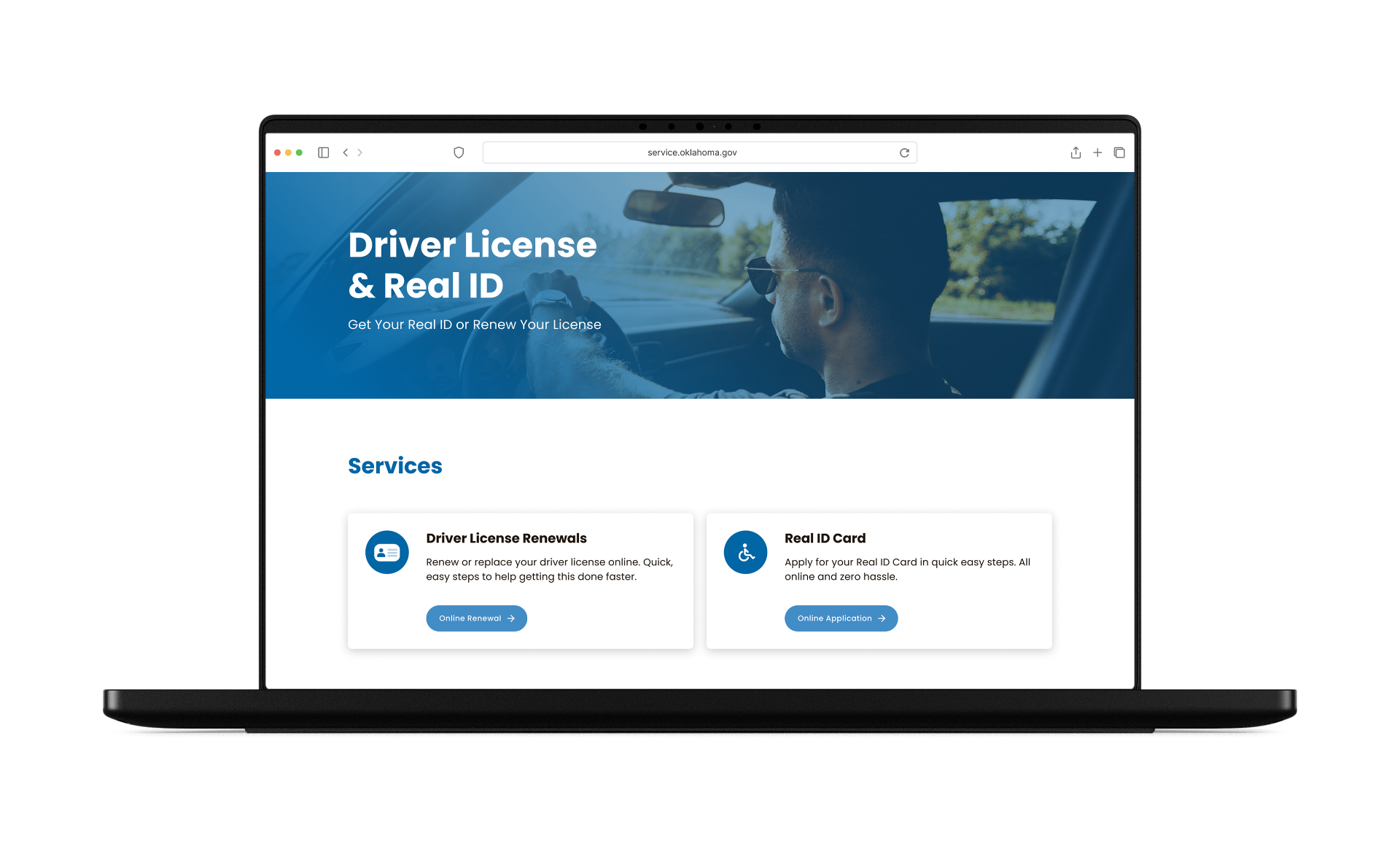
Driver License & Real ID service landing page.
Feature 06

A new Service Oklahoma identity

Problem
The previous branding felt bureaucratic and inconsistent, undermining trust before the first interaction.
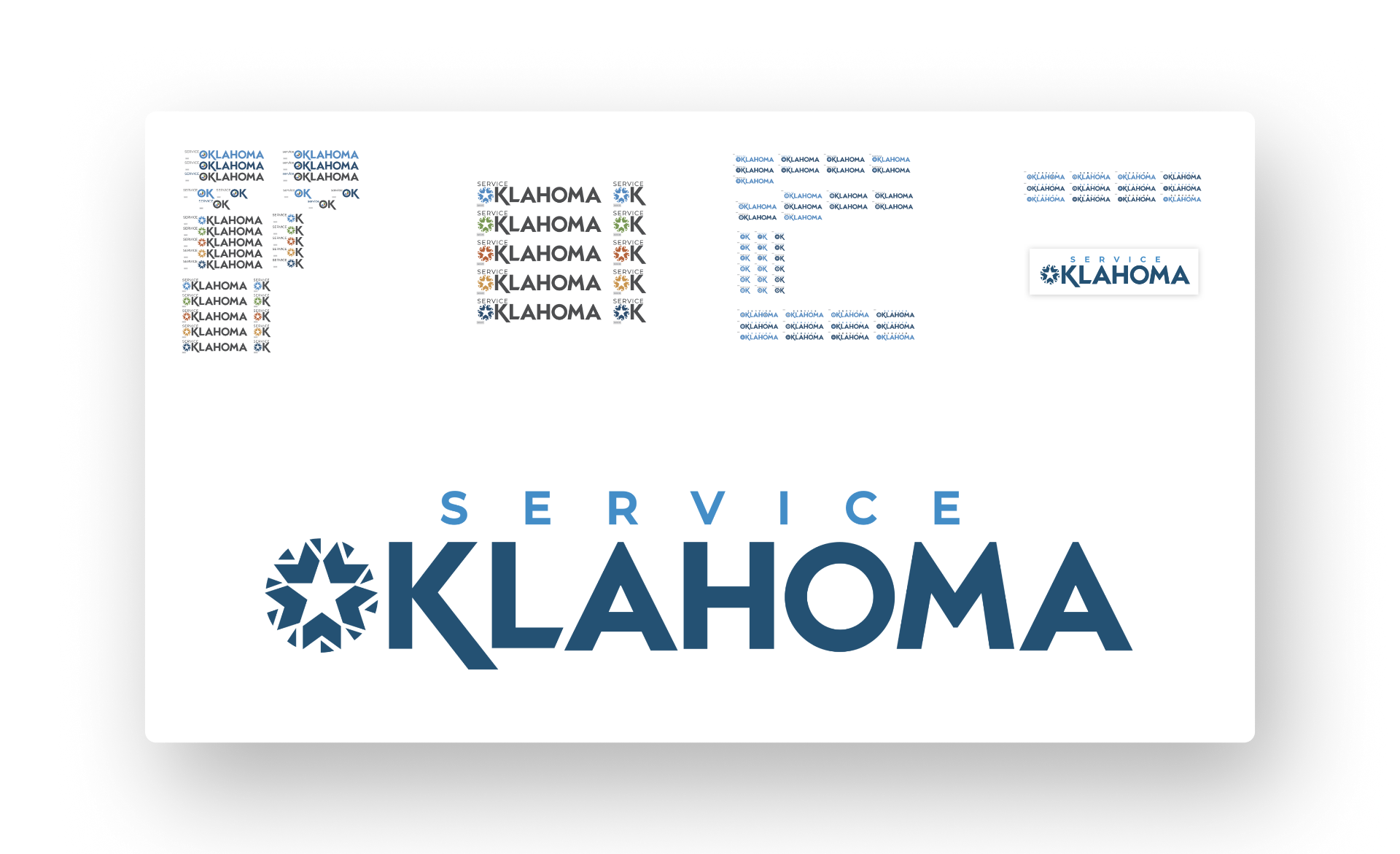
Solution
Designed a modern wordmark paired with a folded-star glyph nodding to the state seal, plus a warm, plain-spoken voice and an accessible color system anchored on the #D4623A accent. Applied end-to-end across renewals, signage, and comms.
Impact
A consistent identity that signals calm authority — recognizable across the web, mobile, tag offices, and printed materials.
Service Oklahoma brand identity system.
Design System

Built to outlast.Launch day.

Every surface ships from a shared system — tokens, components, and patterns documented so future teams can extend the product without re-deriving its rules.

Service Design
Digital Transformation
Information Architecture
Accessibility
Brand & Identity
Design System
The Impact

The outcome.Measured in practice.

From ambiguity to aligned vision

2 weeks

A focused Venture Sprint that compressed weeks of scope debate into one committed direction.

Competing mental models unified

1 narrative

Replaced conflicting stakeholder viewpoints with a single story leadership could rally behind.

Structured sprint cadence

6 phases

From framing the ambiguity to delivering the executive pitch, every phase built toward alignment.

Pitch-ready deliverable

Executive

A polished executive presentation and vision artifacts leadership could carry forward on day one.

Strategic reframe

Life-event

Reorganized the concept around what residents were trying to do — the shared lens that unlocked agreement.

Stakeholders on one direction

Aligned

Leaders left the room with a defensible product vision they could commit to — the alignment artifact the sprint was built to produce.

A Venture Sprint is measured in alignment, not shipped features. In two weeks, Service Oklahoma moved from an ambiguous early-stage concept to a stakeholder-aligned product vision — one narrative, one framework, and one executive-ready pitch that gave leadership the clarity to commit to a direction.

Reflection

What worked.What I'd build next.

What changed

Treating alignment as the deliverable. Framing the sprint around one narrative — instead of features — gave every stakeholder something they could agree on before any pixels were defended.

What surprised me

How much of the alignment came from the pitch itself. Once the vision was told as one story, disagreements that had persisted for months dissolved inside a single room.

What I'd build next

Bring the executive audience into a mid-sprint checkpoint even earlier. The final presentation went smoothly because stakeholders were already inside the thinking — starting that loop on day two would have compressed the timeline further.

Next Chapter

Let's build the nextsuccess story.

Every case study in this portfolio began with a complex problem, an ambitious team, and a decision to build something better. If you’re solving the next one, I’d love to help write its success story.