Brad La Pointe
Enterprise SaaS / Fintech

Bringing same-day title decisions to one of America's largest insurers.

A dual-monitor examiner workbench that turns days of title research into one confident, same-day decision.

Sequoia is an internal desktop workbench for First American Title's global operations teams. Examiners read recorded documents on one monitor, build the legal chain of vesting on the other, and apply conditions, exceptions, and exclusions to individual properties. The MVP shipped in Arizona, California, and Texas and put same-day title insurance decisions within reach at national scale.

Role
Lead Product Designer
Timeline
Nov 2022 – Aug 2023
Industry
Enterprise SaaS / Fintech
Team
PM · 2 engineers · title operations SME · QA · researcher
Why It Mattered

Before the answer,the tension that demanded one.

Title decisions live at the intersection of legal ambiguity, county-level document quirks, and enterprise scale. Every state — sometimes every county — has its own recording conventions, and examiners globally had never had a single place to reason across them.

01

Tool sprawl

Examiners toggled between a document viewer, a legacy vesting tool, a policy database, and Excel to keep track of parcels, blocks, and lots.

02

Legal ambiguity

The same easement or CC&R could apply to one lot, a block of lots, or an entire subdivision. There was no consistent way to express that in the tools.

03

No shared truth

Reviewers re-derived the vesting chain from scratch because nothing captured how the prior examiner had reasoned about it.

04

Distributed teams

Operations spanned the US, India, and the Philippines with different training baselines, which amplified every ambiguity in the workflow.

Good title work depends on expert judgment. The software should make that judgment easier, not harder.
DESIGNING PRINCIPLE
The System

The shape of the problemmade visible.

Signature Visual · Product Strategy

From fragmented recordsto one trusted source of truth.

Title decisions once required experts to reconcile information across disconnected systems. Sequoia consolidated those records into one canonical source of truth.

Before Sequoia

  • County GIS

    Property Record

  • Deed Index

    Current Owner

    Duplicate owner
  • Lien Registry

    Liens

    Missing release
  • Assessor

    Tax Records

  • Underwriter

    Manual Review

After Sequoia

Canonical Title Record

One source of truth

  • Unified ownership
  • Validated history
  • Liens verified
  • Taxes verified
  • Automated validation

Validate Review Decision

10+ systems

became

1 trusted record

Days

became

Hours

The Challenge

Title decisions required experts to reconcile information across multiple disconnected systems before they could confidently issue a policy. Every exception introduced additional manual verification.

The Shift

Sequoia unified fragmented title records into one trusted source of truth, reducing reconciliation and accelerating title decisions from days to hours.

The Opportunity

The betsthat earned the build.

Problem

Title examiners worked across PDFs, spreadsheets, and three legacy tools. A single file took days to clear, and same-day insurance was aspirational rather than operational.

Opportunity

First American already owned the data — recorded documents, prior policies, legal descriptions. Consolidating that into one examiner workspace could compress the entire decision loop.

Outcome

MVP launched in AZ, CA, and TX with a 62 percent reduction in average time-to-clear and same-day decisions on the majority of qualifying orders.

The principles we held to.

  1. 01Two screens, one task — never split a decision across monitors.
  2. 02Show the legal model, not the document soup.
  3. 03Precision by default, prose only when precision fails.
Final Experience

The product.Revealed surface by surface.

Every surface in Sequoia is built around one file, one examiner, and one confident decision. The final MVP focused on the six areas that had the highest impact on time-to-clear and reviewer confidence.

Feature 01

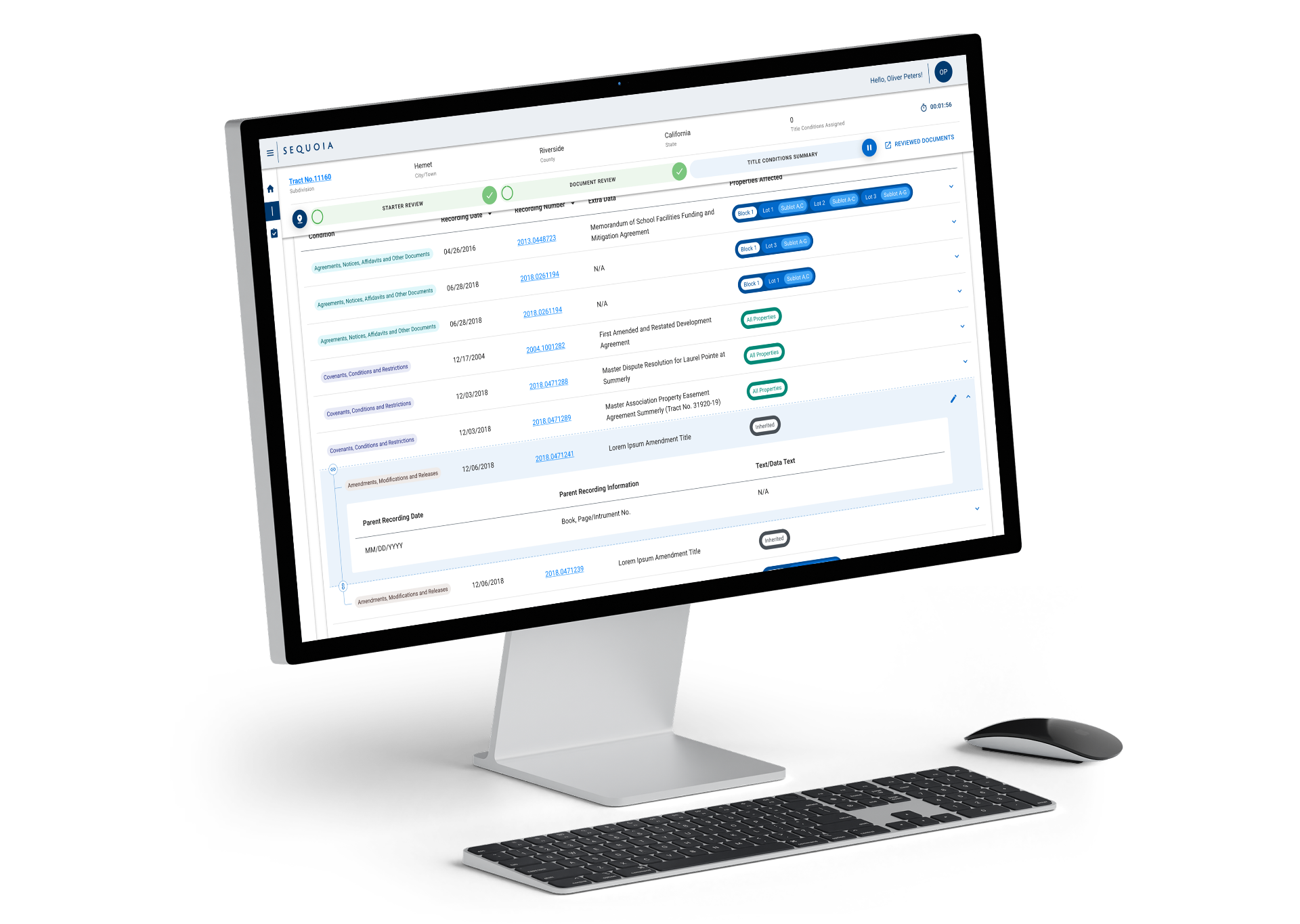
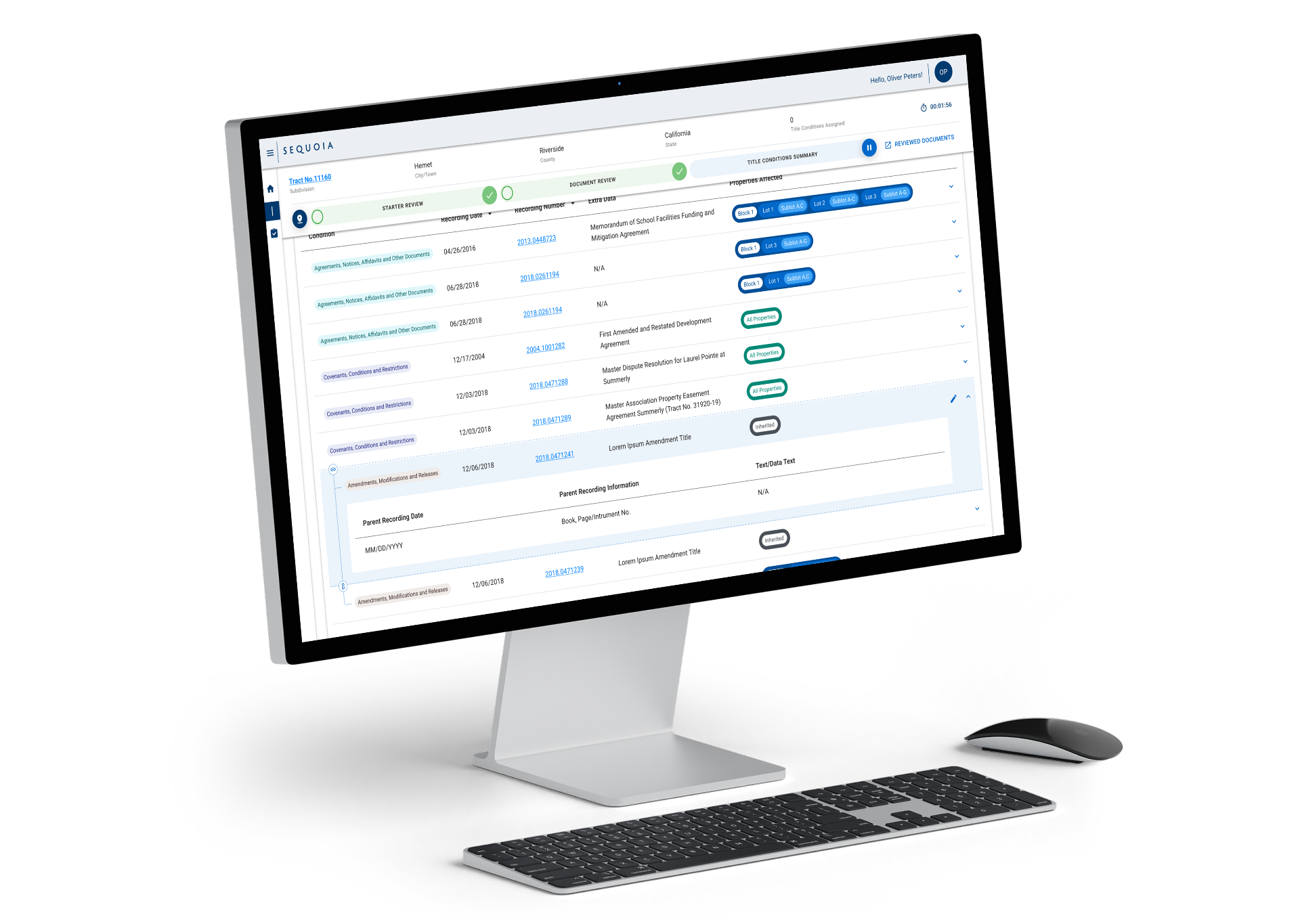
Dual-monitor examiner workbench

Dual-monitor examiner workbench
Problem

Examiners lost minutes per file switching between a viewer, a legacy tool, and Excel.

Outcome

Context switches per file dropped from double digits to near zero.

Feature 02

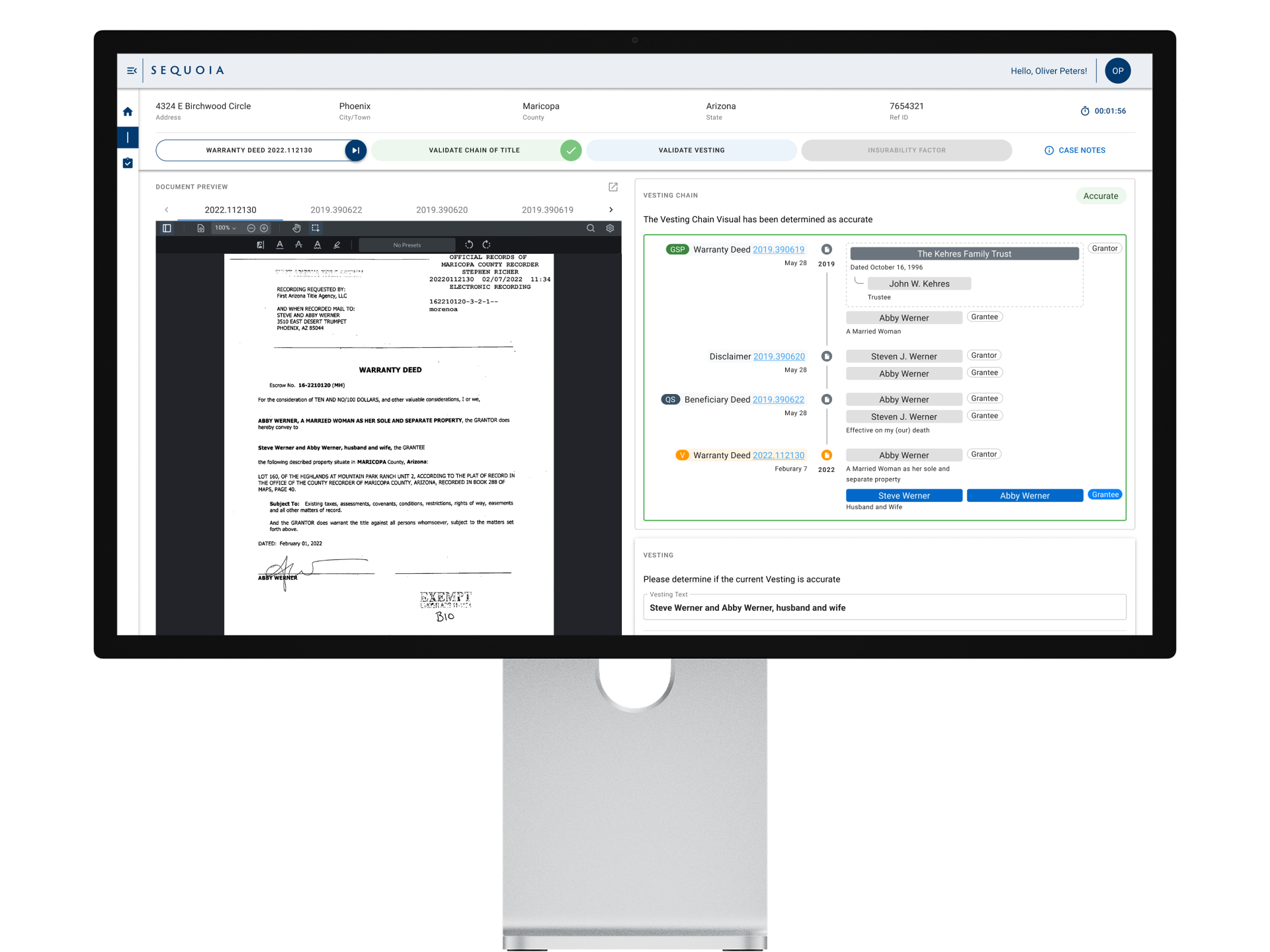
Vesting chain visual model

Problem
Reviewers re-derived vesting from raw document lists on every file.
Solution
The vesting chain renders as a canonical grantor-to-grantee visual with instrument type, date, and disposition, validated once and shared across the team.
Impact
Reviewers accept the prior examiner's chain instead of rebuilding it.
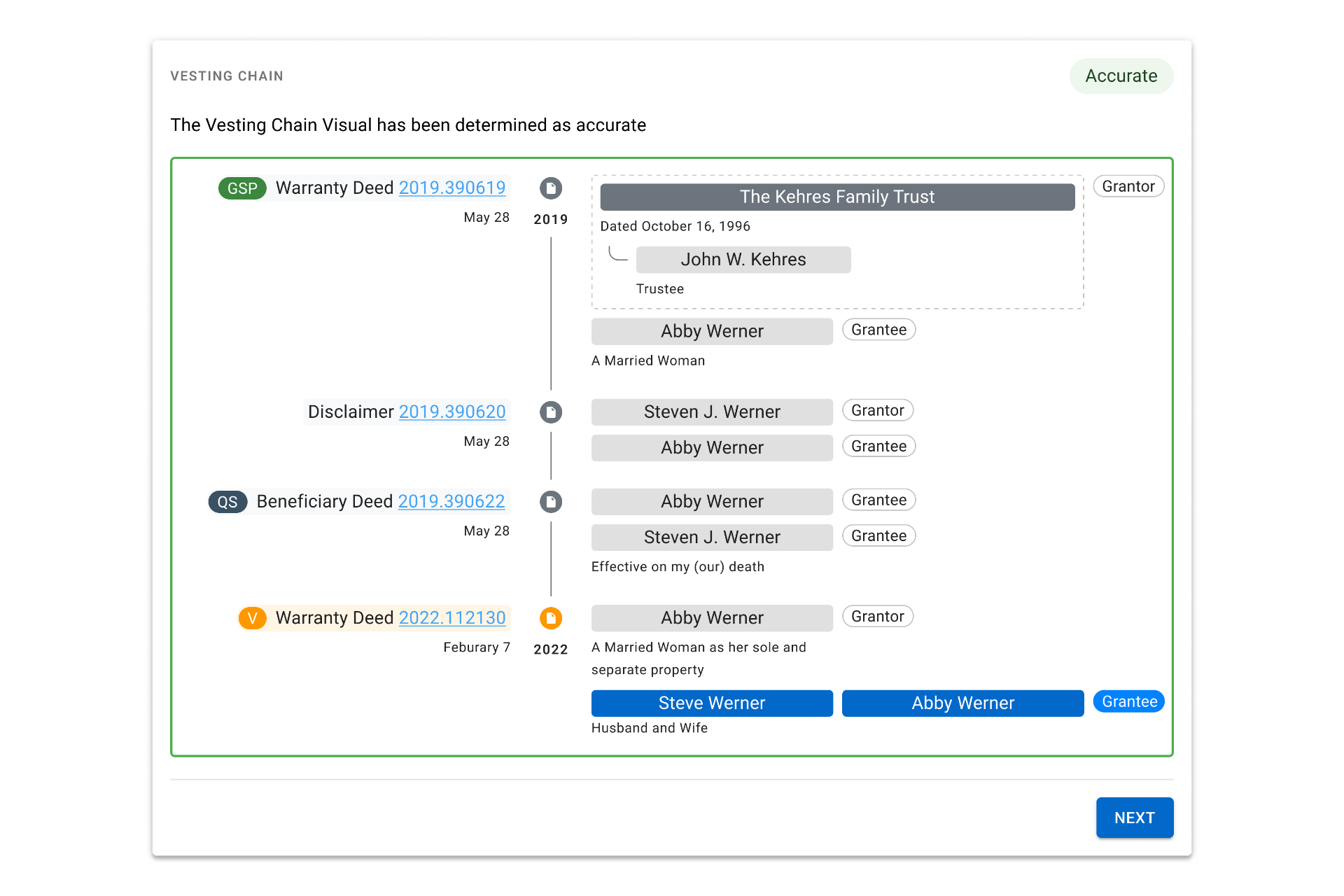
Vesting chain visual model
Feature 03

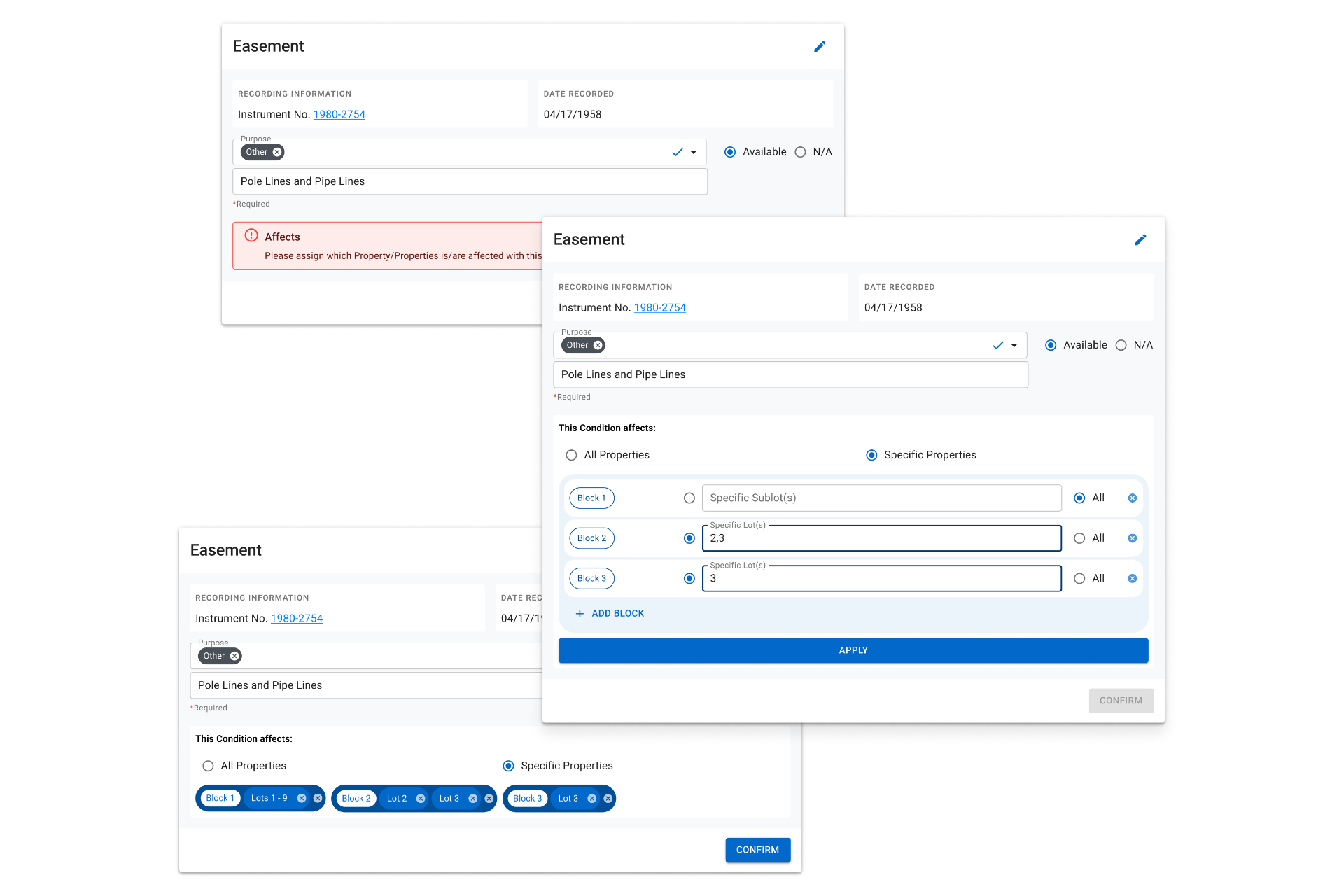
Affected properties with layer hierarchy

Problem
Easements and CC&Rs affect anything from a single lot to an entire subdivision, and the old tools captured it as free text.
Solution
A single card pattern encodes Block → Lots → Sublots/Units → Parcels → Suffix, guiding one, two, or three layer selections with inline example guidelines.
Impact
Ambiguous 'affects' fields effectively disappeared from QA.
Affected properties with layer hierarchy
Feature 04

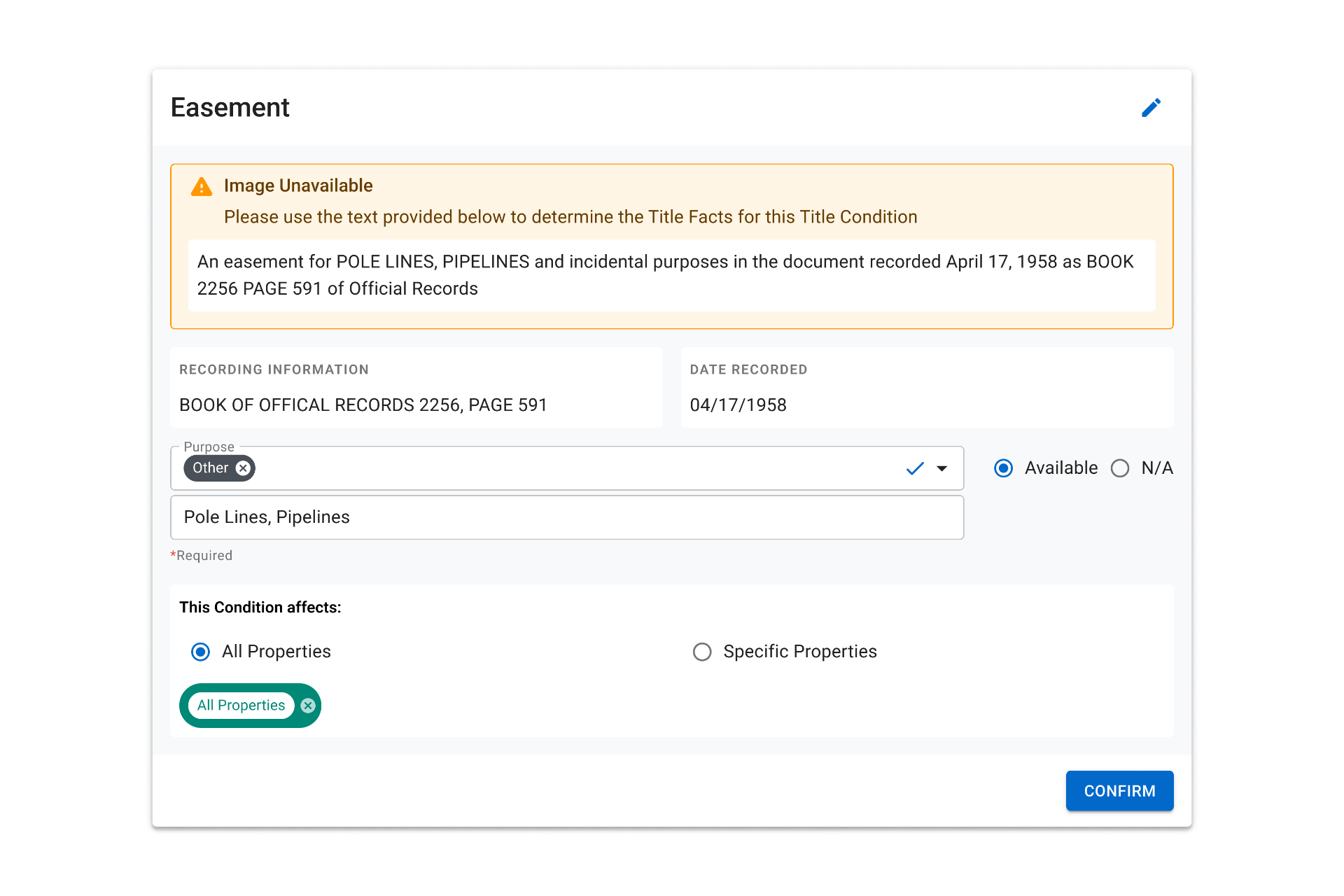
Condition cards for every instrument type

Problem
Every instrument type — Easement, CC&R, plat map, agreements, free-text — had its own bespoke UI in the legacy stack.
Solution
One card shell with typed variants for Easement, CC&R, Plat Map, Amendments and Restrictions, Agreements/Notices/Affidavits, and Free Text.
Impact
Training time for new examiners dropped, and cross-team reviews became consistent.
Condition cards for every instrument type
Feature 05

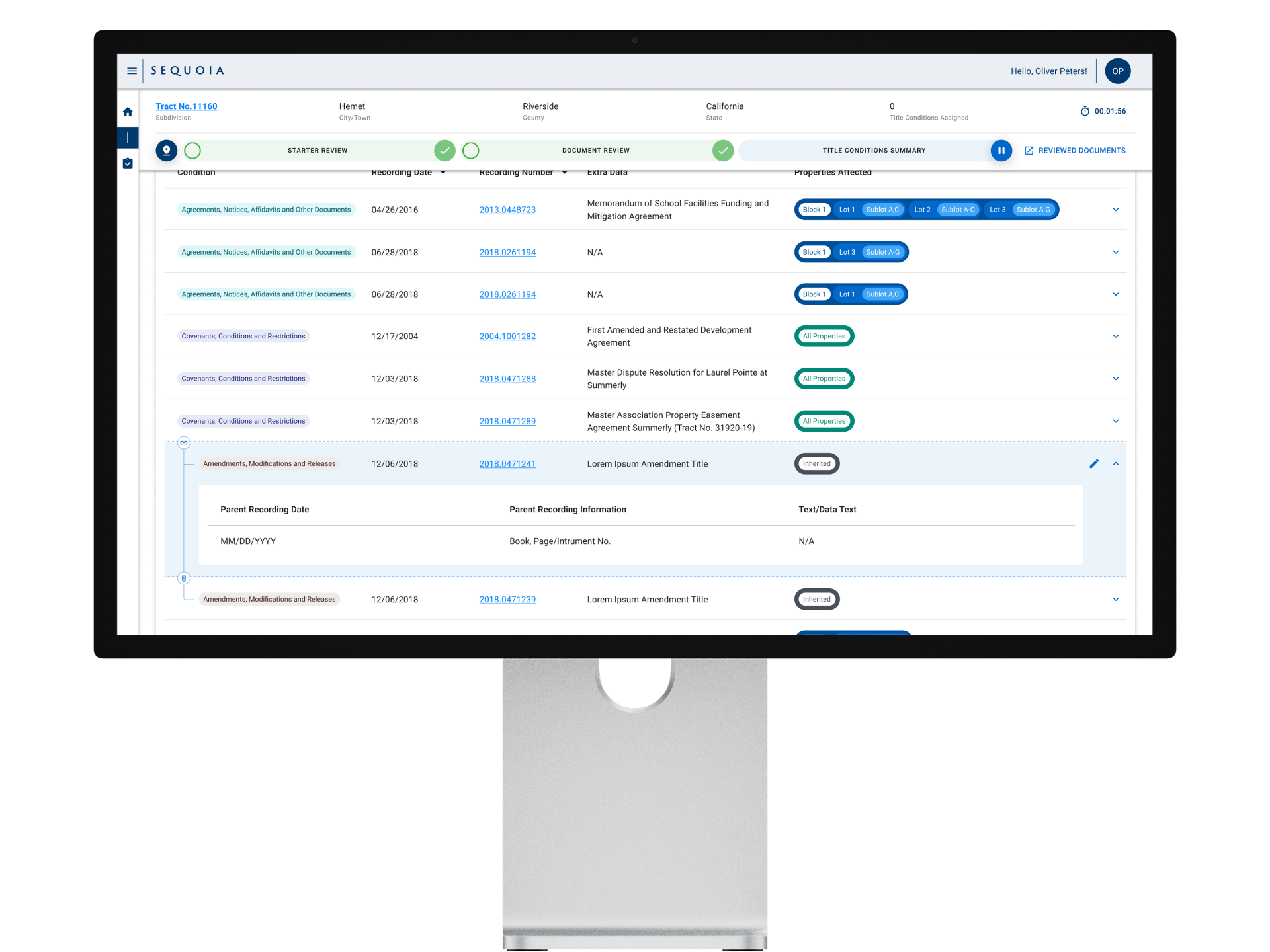
Chips as the scan layer

Problem
Reviewers spent too long opening cards just to see what was affected.
Solution
Every applied condition summarizes into readable chips — Block, Lot, All, Sublot ranges — sitting directly on the collapsed card.
Impact
Reviewers now triage a file in seconds without opening a single card.
Chips as the scan layer
Feature 06

Validate Chain of Title flow

Problem
There was no accepted moment where a file was declared cleared.
Solution
A three-stage flow — Validate Chain of Title → Validate Vesting → Insurability Factor — with per-stage Accurate / Inaccurate decisions and case notes.
Impact
Same-day decisions became a routine outcome, not an exception.
Validate Chain of Title flow
Design System

Built to outlast.Launch day.

Every surface ships from a shared system — tokens, components, and patterns documented so future teams can extend the product without re-deriving its rules.

Enterprise tool
Design system
Data-heavy UI
User testing
0→1
The Impact

A better system.For faster decisions.

Same-day

Title decisions

Designed to support standardized same-day title processing.

Category: Enterprise Platform
Enterprise

Internal platform

Unified fragmented examination workflows into one experience.

Category: Workflow Design
Standardized

Decision making

Created consistent examination workflows across teams.

Category: Systems Thinking
Complex

Data simplified

Transformed dense property information into fast, scannable interfaces.

Category: Information Architecture
Cross-functional

Designed with experts

Built collaboratively with title examiners, product managers, and engineering.

Category: Collaboration
Scalable

Foundation for growth

Created reusable workflows supporting future operational expansion.

Category: Enterprise Systems

Sequoia reimagined title examination as a connected enterprise platform. By standardizing decision-making and surfacing complex property data in clear, actionable interfaces, the product helps title teams move faster, reduce ambiguity, and make consistent decisions at scale.

Reflection

What worked.What I'd build next.

What changed

Modeling the vesting chain as a first-class visual object was the single decision that unlocked reviewer trust. It stopped being a document review tool and started being a shared source of truth.

What surprised me

How much of the workflow was chip-driven. Reviewers made triage decisions from the collapsed card summaries far more than from opening any modal, which reshaped how I prioritized fidelity.

What I'd build next

I would have introduced the layer-hierarchy card in week one of prototyping instead of week four. Every earlier decision had to be revisited once we saw how much clarity it created.

Next Chapter

Let's build the nextsuccess story.

Every case study in this portfolio began with a complex problem, an ambitious team, and a decision to build something better. If you’re solving the next one, I’d love to help write its success story.